

Is Being Spiritual Hot Now?
Carrie Bradshaw would be Shaking in her Chanel right now
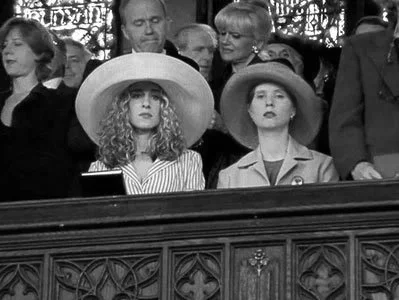
I was (re!)watching Sex & The City; had it on in the background while I was on my computer, and , like so many women, suddenly Carrie Bradshaw was putting into words what I myself was thinking, but hadn’t yet found the words for. This time, though, she was talking about religion, “Are relationships the new religion of the nineties?”.According to the show and this research, in the late nineties, people weren't really going to church anymore… but that doesn’t mean they weren’t still looking for something to believe in. So, as Carrie says, they believed in love. Romantic relationships became the devotion, the thing you organized your life around, the thing you had faith in even when it kept letting you down. Your partner was your higher power. Your brunch table was your congregation (Or so I’m told… I am a proud turn of the century, year of the Dragon baby).But watching that episode now, years after it’s set… it strikes me as important and true, but seems to be describing the opposite of what we’re experiencing. The pendulum didn't just swing. It fully reversed.In 2026, Spirituality IS Hot.
Yes, hot.The Washington Post published a piece a few weeks ago about Gen Z men flocking to Catholic churches in New York City. Not in a quiet, soul-searching way. In a scene way. The 6 p.m. Sunday Mass at St. Joseph's in Greenwich Village has apparently become the place to be: young women in sweater sets and silver crosses, guys with biceps trying to fit into the sleeves of polo shirts, wine socials after the service that have grown from 60 people to 200.One influencer (yes, influencer!!) called it "the ultimate place to date Catholic in New York because it's all the young, beautiful people that go there."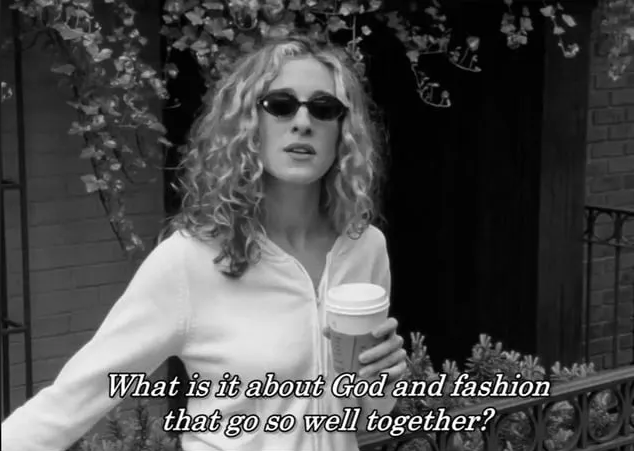
What is it about god and my matching form set that go so well together?
…Carrie Bradshaw would be shaking in her Chanel right now.But it's not just church. A Pew Research study found that 70% of Americans now describe themselves as spiritual in some way. Gallup says a third of Americans identify as spiritual but not religious, and that number keeps climbing. The global wellness economy is projected to hit $7 trillion. The New York Times launched an entire weekly newsletter called Believing because thousands of subscribers literally asked for more spirituality coverage. Meditation apps. Sound baths. Breathwork studios. Crystal shops that look like Apple stores. Yoga studios with brand partnerships.Being deep is cool now!!! I’m so PUMPED because this is 1) exactly what I have wanted in friends, relationships, in life, and 2) is exactly why I built Saltwater - I craved more depth in a surface level world.From not only data but my own experience scrolling socials, chatting with friends, and trying to keep up with a trend-driven culture, having a "practice" is cool. Saying you're "on a journey" is cool. Being "spiritual but not religious" went from something your weird aunt said at Thanksgiving to something people probably put on their hinge profile.Again, I’m stoked about this in a sense. I don't think it’s a bad thing that people are curious about connecting to something bigger than themselves. People are searching for community, for meaning, for something that makes them feel like they're part of something bigger. Those are real needs. It seems like Gen Z kind of figured out that some form of organized (or semi-organized) religion and spirituality is a vessel to get there, to connection, to structure, to belonging. Carrie's generation swapped church for relationships. This generation is instead swapping the hangover diner brunch for the pew.The Pipeline
So let’s step back. This didn't happen overnight. There's a pipeline, and I think it starts with mental health.Over the past few years, mental health went from something you whispered about to something you scream about from the rooftop of your doorman building in Tribeca. And that's genuinely amazing. Therapy is normal. Talking about anxiety is normal. Platforms like Melissa Wood Health built entire communities around the idea that your workout isn't just physical, it's mental, it's emotional, it's meditation and breathwork woven into the same hour as your Pilates. FORM by Sami Clarke did the same thing; mind, body, soul isn't a tagline, it's the whole business model. These platforms normalized the idea that taking care of your mind IS taking care of your health. Not a separate category. Not a side quest.And once that door opened, once we all agreed that health isn't just your body, it makes sense that the next question is: ok, what else is in there? What about the stuff that's harder to name and harder to see? The stuff that isn't a diagnosis or a coping strategy but more of a... feeling? A pull? An ~energy~?That's where the spiritual piece comes in. And the range is huge. On one end, you've got people going back to church, finding God, talking about Jesus openly, not ironically. I’ve even been fed instagram influencers holding bible study via live streams. On the other end, you've got the woo-woo swing: Chinese medicine, energy work, the subtle body, things you can't necessarily see on an X-ray but that people feel. Sound baths. Reiki. Breathwork.. And then there's everything in between, the meditation app ladies, the astrology-curious skeptics, the person who just started saying "I'm spiritual" without totally knowing what they mean yet (hint: that’s OK!). The point is, mental health cracked the door. Spirituality walked through it. And whether that looks like a rosary or a crystal or just sitting quietly with yourself for five minutes, the impulse is the same: there's more to me than what I can see, and I want to pay attention to it.But here’s where it gets a lil bit sticky:There’s a difference between seeking something and performing the search.Performance is sneaky!! You don't always know you're doing it. I've caught myself, more than once, feeling a certain way on my mat and immediately thinking about how I'd describe it to others later, in person or online. Or how it looks to the people next to me, or on camera. That's not practice… that's content. And the line between the two gets thinner every single year in this culture. When spirituality becomes a trend, the first thing that gets commodified is the language. "Manifesting." "Alignment." "Holding space." "Energy." These words can mean something real, and they can also mean absolutely nothing; it depends entirely on who's saying them and why. When a wellness brand uses "alignment" to sell a $90 candle, that's not spirituality. That's (good) marketing. And the church thing, I really am not here to judge anyone's reason for walking through those doors. If you show up to St. Joseph's because you think the guy across the pew is cute and you stay because something in the homily hit you in a way you didn't expect? Well, thats awesome. We don't always arrive for the right reasons and that’s ok. But if you show up just so you can tell your friends at the bar later that you went to church… that's a different thing entirely.The trend isn't the problem. The trend might actually be the door.The question is what happens after you walk through it.So What Actually Makes Something Spiritual?
This is the part where being a yoga teacher is both a gift and…. a headache. Because I see this play out on the mat constantly, and it's never as clean as "real vs. fake."Example numero uno:There's someone in child's pose the entire class. Are they doing yoga? Maybe. It depends on what's happening in their mind. If they're dropping in, listening to their body, choosing stillness because that's what they need, that's yoga. If they're scrolling through their mental to-do list and waiting for savasana, it's just… lying on the floor. Both look exactly the same from the outside.Then there's the person next to you who drops into hanumanasana (splits) effortlessly. Showing off? Or is their body genuinely craving that depth, and they're honoring it? And the person adding push-ups to every vinyasa, are they performing strength, or are they using intensity to drop into focus? And the person who ditches the sequence entirely and makes up their own flow, are they being rebellious, or are they actually practicing the deepest form of self-study by listening to what their body is asking for?You literally cannot tell from the outside. The pose doesn't make it yoga. The intent does.And I think that's the whole answer to whether being spiritual is "hot" now, as a trend, or whether it's real. It's not one or the other. It's both, happening simultaneously, sometimes in the same room, sometimes in the same person, sometimes in the same moment.Doubt Doesn't Disqualify You
Here's the thing I keep coming back to, and I think it's the most important part: can you have doubt about why you're there and still be spiritual?What if you signed up for the meditation class because it seemed like the kind of thing a thoughtful person would do? What if you went to church partly because your friend said it was the scene? What if you started a yoga practice partly because it photographs well?That doesn’t disqualify you... At all.
In yoga philosophy, there's a concept called Svādhyāya, self-study. We've talked about it in previous editions. And Svādhyāya isn't about arriving with pure intentions. It's about being honest about the intentions you actually arrived with. The practice doesn't ask you to be spiritual. It asks you to notice why you're being spiritual, and to keep showing up anyway, even when the answer is messy.
Because here's what tends to happen: you walk in for the trend and something real catches you off guard. The breath drops you somewhere you didn't plan to go. The silence gets loud in a way you weren't prepared for. The person next to you is crying in savasana and suddenly the whole thing feels a lot less aesthetic and a lot more human.
That's the moment. Not when you arrived looking perfect with your matching set and your Stanley cup. The moment you forgot you were being watched.So… yes, being spiritual is hot right now.And honestly, f**k yeah!!! More people sitting in silence, moving their bodies, thinking about something bigger than themselves, looking for community in a world that is so desperate for it, that is not a problem.
But the practice, the real one, the one that actually changes you, starts when you ask yourself one question: Would I still do this if nobody ever knew I did it?
Not to guilt yourself. Just to check in.Because sometimes the answer is absolutely yes // And sometimes the answer is… hmm.And that "hmm" is the whole practice. That's the Svādhyāya. Not the pose. Not the prayer. The honesty.. the study of the Self.
When the answer is a straight up “No”, and we keep doing it anyways, that’s a problem that warrants action. When it distracts or dilutes the spirituality practices of others around you, aka if you show up to a community and don’t match the effort of others, or worse, judge the other people there, there needs to be pause.
Carrie was onto something. We do tend to worship whatever makes us feel like we belong. Relationships then, spirituality now. The object changes; the pattern doesn't. But maybe the pattern isn't the problem either. Maybe the only thing that matters is whether you're paying attention to it.More reading (for the nerds like mwah):Melissa Wood Health - the platform that made "mind, body, soul" an actual wellness modelFORM by Sami Clarke - holistic fitness that treats mental health as a main course, not the side questWhy Catholicism Is Drawing in Gen Z Men - The Washington Post - the Gen Z church scene in NYCSpirituality Among Americans - Pew Research Center - 70% of Americans describe themselves as spiritualIn U.S., 47% Identify as Religious, 33% as Spiritual - Gallup - the "spiritual but not religious" numbersThe New York Times Starts a Newsletter on Religion - MediaPost - the launch of the Believing newsletter